
Methanol, Fischer-Tropsch liquids and fuels derived from them can be made from natural gas or from hydrogen and captured CO2. They use existing engines, tanks and distribution systems, which is why they are studied for aviation and shipping, where batteries and hydrogen are hard to apply. The technology is not new: Sasol has operated Fischer-Tropsch plants in South Africa since the 1950s, and Shell started its Pearl gas-to-liquids (GTL) plant in Qatar in 2011. What has changed is the demand for low-carbon versions, which depends on cheap low-carbon hydrogen or on carbon capture. For hydrogen routes, see our guide to Hydrogen Production from Petroleum.
Methanol synthesis
CO + 2H2 → CH3OH, ΔH ≈ −90.7 kJ/mol
CO2 + 3H2 → CH3OH + H2O, ΔH ≈ −49.5 kJ/mol
CO2 + H2 → CO + H2O, ΔH ≈ +41.2 kJ/mol
M = (H2 − CO2) / (CO + CO2)
Industrial plants use copper-zinc oxide catalysts at roughly 220 to 280 °C and 50 to 100 bar, with a syngas module M slightly above 2. Conversion per pass is limited by equilibrium, so unreacted gas is recycled and a purge removes inerts.
Synthetic example: e-methanol from CO2 and electrolytic hydrogen. Stoichiometry gives 3 × 2/32 = 0.1875 kg H2 and 44/32 = 1.375 kg CO2 per kg of methanol. For 100,000 t/yr: 18,750 t H2 and 137,500 t CO2. At 55 kWh/kg H2 (assumed) the electrolysers use 1,031 GWh/yr, or 130.8 MW at 90% availability. Adding 1,000 kWh-equivalent per tonne of captured CO2 and 250 kWh/t for compression and utilities (both assumed) gives 11,938 kWh per tonne of methanol, against an energy content of 5,528 kWh/t (LHV 19.9 MJ/kg): an overall efficiency of 46%. Carbon capture energy is mostly heat; converting it to an electrical equivalent is a simplification.
Burning the methanol releases the CO2 it contains, 1.375 t per tonne. Its climate benefit therefore depends on the origin of the CO2, the emissions of the electricity used and the accounting rules: CO2 taken from a fossil point source is emitted once, at the end of the chain.
Fischer-Tropsch synthesis
Fischer-Tropsch synthesis builds hydrocarbon chains from CO and H2 on cobalt or iron catalysts. The Anderson-Schulz-Flory model gives the weight fraction of chains with n carbon atoms from the chain growth probability α:
Wn = n (1 − α)² αn−1
Synthetic example, α = 0.90: C1 1.0%, C2-C4 7.2%, C5-C12 29.7%, C13-C22 30.6%, C23+ 31.5% by weight. Low-temperature cobalt processes aim at high α and hydrocrack the wax to middle distillates.
GTL economics
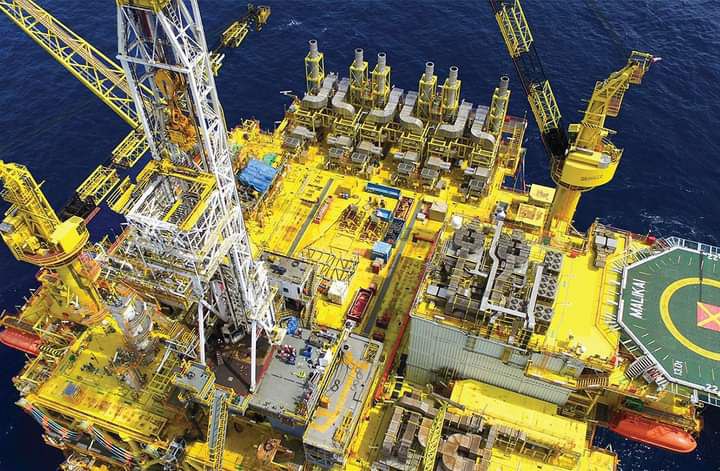
Pearl GTL produces 140,000 b/d of liquid products from about 1.6 billion cubic feet per day of gas, together with natural gas liquids and ethane; its cost was reported at about $18 billion in 2007, with later estimates up to $24 billion.
Synthetic example. A 140,000 b/d plant, 5.8 GJ per barrel of product, a 60% overall energy efficiency, gas at $4/GJ, 350 operating days, operating costs of $850 million per year and capital of $18.5 billion recovered over 25 years at 12% (capital recovery factor 0.1275): gas costs $1,895 million and capital $2,359 million per year. With products sold at the crude price plus $7/bbl (all assumed), the break-even crude price is $97/bbl; with gas at $2/GJ it is $78/bbl. The result is driven mostly by capital cost, which is why few large GTL plants have been built.
Methanol to jet fuel
Methanol can be converted to olefins on zeolite catalysts, then oligomerised, hydrogenated and fractionated into jet-range hydrocarbons, with gasoline and diesel as co-products. Stoichiometry sets an upper limit: CH3OH → (CH2) + H2O gives at most 14/32 = 0.4375 kg of hydrocarbons per kg of methanol, jet fuel and co-products together. Any process data quoting higher combined yields are inconsistent with the mass balance.
The carbon in the fuel returns to the atmosphere when it burns. A methanol-to-jet fuel does not remove CO2; at best it avoids fossil carbon, and its life-cycle intensity depends on electricity, CO2 source and process energy. Under CORSIA, an eligible fuel must achieve at least a 10% reduction in life-cycle emissions against the jet fuel baseline of 89 g CO2e/MJ.
Mandates and ticket cost
The EU ReFuelEU Aviation regulation sets minimum shares of sustainable aviation fuel of 2% in 2025, 6% in 2030, 20% in 2035, 34% in 2040, 42% in 2045 and 70% in 2050, including synthetic fuel sub-targets of 1.2% on average in 2030-2031, 5% in 2035 and 35% in 2050.
Synthetic example. A flight burning 7,000 L of fuel with 180 passengers, fossil jet fuel at $0.75/L and e-fuel at $6.00/L (assumed). The extra cost of the blend is 7,000 × share × (6.00 − 0.75): $735 per flight (about $4 per passenger) at 2%, $2,205 ($12) at 6% and $12,495 ($69) at 34%. A real blend also includes cheaper bio-based SAF, so these values are an upper bound for the stated prices.
Blue methanol
Synthetic example. A 500,000 t/yr plant using 29.7 GJ of gas per tonne at $4.4/GJ ($65.3 million per year), capital of $1,050 million recovered over 20 years at 10% (factor 0.1175, $123.4 million per year), operating costs of $126 million per year, and 0.95 t CO2 per tonne captured at 91.6% and valued at $85/t ($37.0 million per year): production cost $556 per tonne. Every input is an assumption; market methanol prices and carbon values vary by region and year and must be taken from current data.
Related processes
For a refinery route that upgrades heavy residues, see Delayed Coking: Drum Operation, Coke Morphology, Resid Conversion Chemistry, and Delayed Coker Economics.
References
- Regulation (EU) 2023/2405 (ReFuelEU Aviation), as summarised by the Clean Hydrogen Partnership observatory
- ICAO, CORSIA eligible fuels, life-cycle baseline 89 g CO2e/MJ
- Pearl GTL capacity and cost as reported publicly (Wikipedia summary of company and press sources)