
Delayed coking converts vacuum residue, the heaviest and most contaminated part of the crude barrel, into gas, naphtha, light and heavy coker gas oils, and petroleum coke. It is the most widely used residue conversion process where heavy crudes are run, because it removes low-value residue from the product slate without hydrogen or catalyst, by rejecting carbon as coke. This guide covers the cracking chemistry and yield estimation, the effect of heater outlet temperature, coke drum sizing and the drum cycle, coke types, and a simple comparison of coker and visbreaker economics.
To place residue conversion within the refinery flow scheme, start with crude oil atmospheric distillation and product cut-point selection, then follow the heavier fractions through vacuum distillation to coker feed.
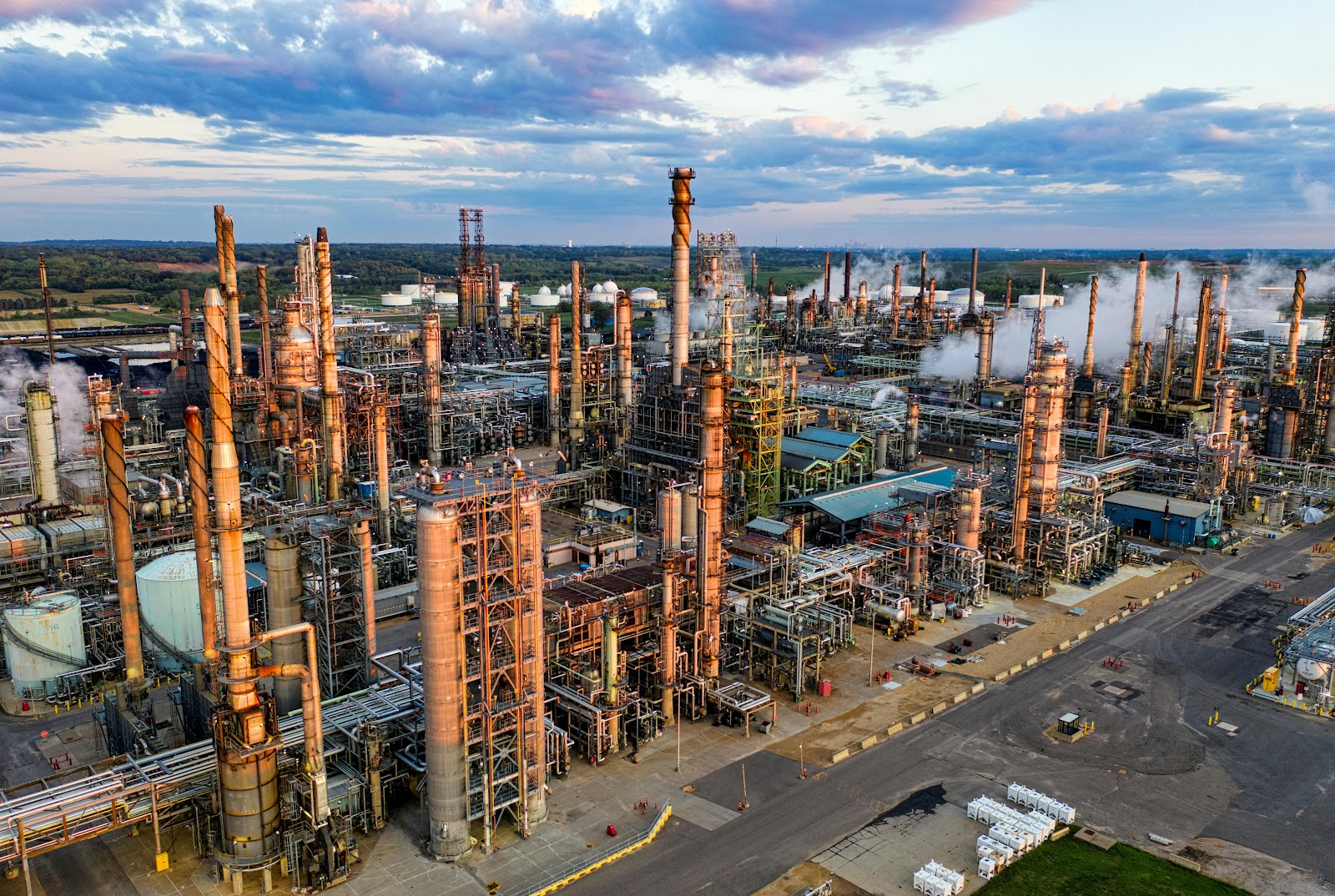
Feed properties, yields, prices and costs below are a synthetic teaching example.
1. Chemistry and yields
1.1 Thermal cracking and coke formation
Coking is thermal cracking by free radicals. Above roughly 480 °C, C−C bonds break homolytically; the radicals abstract hydrogen or undergo β-scission, giving lighter paraffins and olefins. Aromatic radicals combine into larger polyaromatic structures that eventually separate from the liquid as a mesophase and then solid coke. Cracking is endothermic overall, so the heat is supplied by the fired heater and the drum temperature falls during the cycle.
The process is called delayed because the feed is heated quickly in the heater tubes at high velocity, often with injected steam, so that little coke forms there; the coking reactions take place in the large drum, which provides hours of residence time.
1.2 Yield estimate from Conradson carbon
A common screening correlation (Gary and Handwerk) gives the delayed coker coke yield as about 1.6 times the Conradson carbon residue (CCR) of the feed. For a vacuum residue with CCR = 20 wt%, the coke yield is about 32 wt%. The rest of the slate below is assumed for the example.
| Product | Yield, wt% | Density, kg/m³ | Rate |
|---|---|---|---|
| Coke | 32 | 14.90 kg/s = 1,287 t/d | |
| Gas (C1 to C4, H₂S) | 8 | 3.72 kg/s | |
| Naphtha | 12 | 780 | 3,890 bbl/d |
| Light coker gas oil | 22 | 870 | 6,400 bbl/d |
| Heavy coker gas oil | 26 | 890 | 7,390 bbl/d |
The feed is 27,500 bbl/d of vacuum residue at 920 kg/m³, that is 46.56 kg/s. The liquid products total about 17,680 bbl/d. Volumes are mass divided by density, then divided by 0.158987 m³ per barrel.
1.3 Heater outlet temperature
Raising the heater outlet temperature (HOT) increases cracking severity, lowers the coke yield and its volatile matter, and shifts yield toward gas and lighter liquids, but it also accelerates heater tube coking. The example assumes the following shifts for +10 °C: coke −1.6 wt%, gas +1.0, naphtha +0.6, light gas oil +0.2, heavy gas oil −0.2.
| Product | Change | Value per day |
|---|---|---|
| Coke ($55/t) | −64 t/d | −$3,540 |
| Gas ($220/t) | +40 t/d | +$8,850 |
| Naphtha ($85/bbl) | +195 bbl/d | +$16,540 |
| Light gas oil ($98/bbl) | +58 bbl/d | +$5,700 |
| Heavy gas oil ($90/bbl) | −57 bbl/d | −$5,120 |
| Net | +$22,440 per day, about $8.2M per year |
If the higher temperature shortens the heater run from 18 to 14 months, there is about one extra decoke every five years (3.3 versus 4.3); at an assumed $1.5M per event that costs about $0.3M per year, so the severity increase remains attractive in this example, subject to heater tube metal temperature limits and coke quality.
2. Coke drum sizing and operation
2.1 Drum volume
The example uses one pair of drums with an 18-hour fill: one drum fills while the other is steamed, quenched, cut and prepared.
| Quantity | Calculation | Result |
|---|---|---|
| Coke per drum cycle | 1,287 t/d × 18/24 | 965 t |
| Coke volume (in-drum density 800 kg/m³, assumed) | 965,400 / 800 | 1,207 m³ |
| Drum volume with 20% outage above the coke | 1,207 / 0.80 | 1,508 m³ |
| Diameter for H/D = 3.7 (cylinder only) | (1,508 / (π/4 × 3.7))1/3 | 8.04 m, so 8.0 m |
| Height | 3.7 × 8.0 | about 30 m |
The vapor velocity check uses a Souders-Brown form with a low factor for this strongly foaming service, K = 0.03 m/s, liquid density 800 kg/m³ and an assumed vapor density of 4.5 kg/m³:
umax = 0.03 × ((800 − 4.5)/4.5)0.5 = 0.399 m/s
The vapor leaving the drum is 68% of the feed, 31.7 kg/s or 7.04 m³/s, which needs 17.6 m² of cross-section, a 4.74 m diameter. The 8.0 m drum set by coke volume therefore has a large vapor margin. Foam height is still monitored during filling (for example with nuclear level detectors), and antifoam is injected near the end of the fill.
2.2 Drum cycle
- Fill (18 h): hot feed enters the bottom; vapors leave overhead to the main fractionator.
- Steam out: steam strips hydrocarbons from the coke bed, first to the fractionator and then to the blowdown system.
- Water quench: water cools the bed slowly to avoid thermal shock to the drum shell.
- Drain and unhead: water is drained and the top and bottom heads are opened.
- Hydraulic decoking: a high-pressure water jet first bores a pilot hole, then a cutting tool removes the coke, which falls to a pit or pad.
- Rehead, pressure test, purge and warm-up: the empty drum is heated with vapors from the active drum before it is switched into service.
All off-line steps must fit within the 18-hour fill of the companion drum. For the decoking pump, an example duty of 750 L/min at 350 bar needs a hydraulic power of 350 × 105 × 0.75/60 = 438 kW, about 580 kW of shaft power at 75% efficiency.
3. Coke types
| Type | Structure and origin | Main uses |
|---|---|---|
| Sponge coke | Porous, irregular; from ordinary vacuum residues | Fuel grade if high in sulfur and metals; anode grade after calcining if low in sulfur and metals |
| Shot coke | Small hard spheres, favoured by high asphaltene and low severity | Fuel grade; can be hard to handle and to cut |
| Needle coke | Highly oriented anisotropic structure from very aromatic, low-sulfur, low-asphaltene feeds such as FCC decant oil or coal tar pitch | Graphite electrodes for electric arc furnaces and synthetic graphite for battery anodes |
| Calcined anode coke | Sponge coke calcined at high temperature to remove volatiles | Carbon anodes for aluminium smelting |
Needle coke needs a dedicated feed and operating window (typically higher drum pressure and longer cycles than fuel-grade coking) and is limited by the availability of suitable feed. Sulfur, metals, volatile matter and other specifications are set by the buyer for each grade.
4. Economics
4.1 Delayed coker
In the example the vacuum residue would otherwise be sold as fuel oil at $45/bbl. The product values are those of intermediate streams; naphtha and gas oils still need hydrotreating or further conversion.
| Item | Calculation | Value per year |
|---|---|---|
| Naphtha | 3,892 bbl/d × $82 | $116.5M |
| Light gas oil | 6,398 bbl/d × $98 | $228.9M |
| Heavy gas oil | 7,391 bbl/d × $90 | $242.8M |
| Coke | 1,287 t/d × $50 | $23.5M |
| Gas (fuel value) | 321.8 t/d × $220/t | $25.8M |
| Total products | $637.5M | |
| Residue as fuel oil | 27,500 bbl/d × $45 | $451.7M |
| Incremental value | $185.8M | |
| Operating cost (assumed) | $90M | |
| Net operating benefit | $95.8M |
With an assumed capital cost of $375M, the simple payback is 3.9 years. Over 25 years at 12% (present value factor 7.843), the NPV is 95.8 × 7.843 − 375 = $376M before tax. The result is very sensitive to the price difference between light products and high-sulfur fuel oil, which is the main driver of coking investments.
4.2 Visbreaking as an alternative
Visbreaking is mild thermal cracking (a coil or soaker at lower temperature than a coker) that lowers residue viscosity, reducing the cutter stock needed to make fuel oil, but converts only a small part of the residue. With assumed yields of 2 wt% gas, 5 wt% naphtha, 8 wt% gas oil and 85 wt% visbroken residue (960 kg/m³, valued at $48/bbl):
| Item | Rate | Value per year |
|---|---|---|
| Naphtha | 1,643 bbl/d × $82 | $49.2M |
| Gas oil | 2,353 bbl/d × $98 | $84.2M |
| Visbroken residue | 22,401 bbl/d × $48 | $392.5M |
| Less residue as fuel oil | 27,500 bbl/d × $45 | −$451.7M |
| Incremental value | $74.1M |
The visbreaker captures about 40% of the coker incremental value, for a much smaller investment. It suits refineries with a fuel oil outlet and limited capital; deep conversion of residue needs coking, solvent deasphalting or residue hydrocracking.
Key points
- Coking is endothermic thermal cracking; the heater supplies the heat and the drum provides the residence time.
- A 20 wt% CCR residue gives about 32 wt% coke, 1,287 t/d from 27,500 bbl/d.
- The liquid products are about 3,890, 6,400 and 7,390 bbl/d of naphtha, light and heavy gas oil.
- +10 °C on the heater outlet is worth about $8.2M per year in the example before extra heater decoking.
- An 8.0 m by 30 m drum holds one 18-hour cycle of coke; vapor velocity is not limiting.
- The decoking pump in the example needs about 440 kW of hydraulic power, not several megawatts.
- With residue at $45/bbl, the coker earns $95.8M per year net and an NPV of about $376M at 12%.
References
- J. H. Gary, G. E. Handwerk and M. J. Kaiser, Petroleum Refining: Technology and Economics, 5th ed., CRC Press, 2007.
- R. A. Meyers (ed.), Handbook of Petroleum Refining Processes, McGraw-Hill.
- J. G. Speight, The Chemistry and Technology of Petroleum, CRC Press.
- P. J. Ellis and C. A. Paul, Tutorial: Delayed coking fundamentals, AIChE Spring National Meeting, 1998.
- API RP 934-G, Design, Fabrication, Operational Issues, and Inspection Guidelines for Coke Drums and Peripheral Components in Delayed Coking Units, American Petroleum Institute.
Related reading and community
Questions about coker design for a specific residue? Join our Telegram group for delayed coking and residue conversion discussions, or visit our YouTube channel for step-by-step tutorials on coke drum sizing, yield prediction and coker economics.