
The contract between a host government and an oil company decides how the value of every barrel is shared for decades. Engineers do not negotiate these terms, but they need to understand them: the fiscal regime changes which projects are economic, how fast costs are recovered and what an extra well or a cost saving is really worth to each party. This guide explains the main structures and calculates the key mechanisms with synthetic numbers. It does not describe any country's current terms; always use the contract and the applicable law.
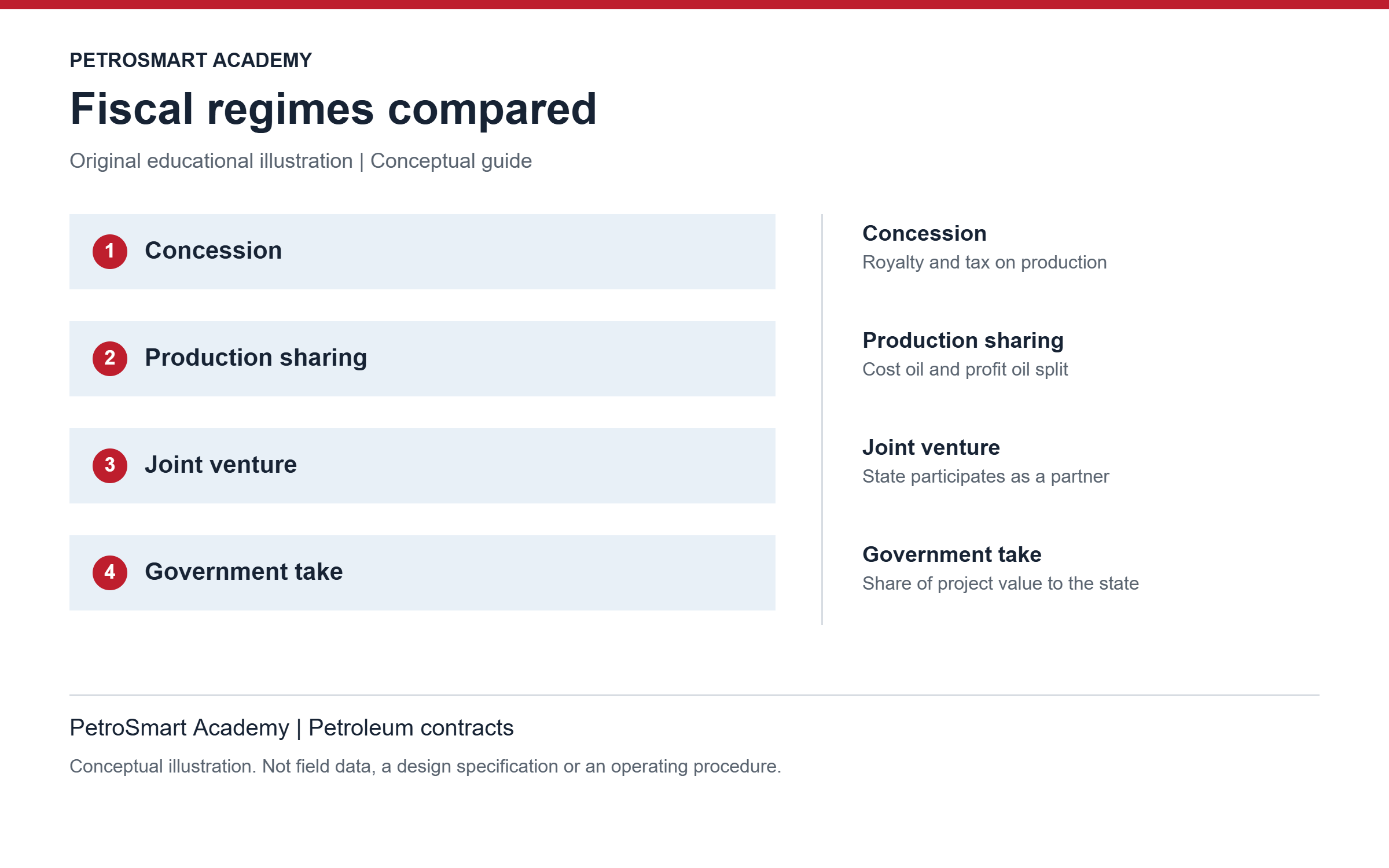
1. The main contract families
- Concession (tax and royalty): the company holds the right to explore and produce and owns the oil at the wellhead; the state is paid through bonuses, royalty and taxes.
- Production sharing contract (PSC): the state (often through a national oil company) owns the resource; the contractor bears the costs and risk and is paid in kind through cost oil and a share of profit oil, usually also paying income tax.
- Service contract: the contractor is paid a fee per barrel or a cost-plus fee and does not take title to production.
Each contract also sets work obligations (seismic, wells) for the exploration period, relinquishment rules, state participation, local content and decommissioning obligations.
2. Royalty: fixed rate against sliding scale
Synthetic sliding scale applied by tranche: 5% on the first 5,000 bbl/d, 10% on the next 15,000, 15% on the next 30,000 and 20% above 50,000 bbl/d. At 85,000 bbl/d the royalty is 250 + 1,500 + 4,500 + 7,000 = 13,250 bbl/d, an effective rate of 15.6%. At $68/bbl this is $328.9 million per year, against $263.7 million at a flat 12.5%: $65.2 million more for the large field. For a 4,000 bbl/d field the same scale takes only 200 bbl/d instead of 500 bbl/d. A sliding scale on production rate therefore favours small fields, while a flat royalty, charged on gross revenue whatever the costs, can make marginal fields uneconomic.
3. Ring fencing
A ring fence stops a company from deducting costs in one licence against income in another. Synthetic case: a $85 million exploration loss on block A and a $320 million profit on block B, with a 30% tax. With consolidation, tax is 30% × 235 = $70.5 million; with a ring fence around block B, tax is 30% × 320 = $96 million, until (if allowed) the loss is used later inside block A.
4. PSC cost recovery: one year in detail
Synthetic year: 11.68 MMbbl produced at $68/bbl, gross revenue $794.2 million; cost recovery limit 65% of revenue ($516.3 million). Costs eligible this year: opex $145.0 million, depreciation of capital $121.4 million ($850 million over 7 years), and $38.5 million carried forward from earlier years, a total of $304.9 million, fully recovered because it is below the limit.
Profit oil = 794.2 − 304.9 = $489.3 million. With an R-factor below 1 (cumulative contractor receipts / cumulative contractor spending), the contractor share is 30%: $146.8 million, taxed at 45% ($66.1 million). The state receives 70% of profit oil plus the tax, $408.6 million, or 83.5% of this year's profit oil.
The contractor's cash flow must not be confused with its cost recovery. Depreciation and carried-forward costs were paid in earlier years, so if no new capital is spent this year the contractor's cash flow is 304.9 + 146.8 − 66.1 − 145.0 = $240.7 million. Subtracting the carried-forward amount again as if it were spent this year would understate it.
5. Joint ventures and farm-ins
Most licences are held by several companies under a joint operating agreement (JOA). Each holds a working interest (WI) and pays that share of costs. Where a royalty applies, the net revenue interest is the share of revenue after royalty, for example 30% × (1 − 0.125) = 26.25%. The operator runs the work, non-operators approve budgets and AFEs above the thresholds set in the JOA, and a party that declines a sole-risk or non-consent operation usually loses its share of that operation's production until the participants recover their costs plus a premium defined in the JOA.
Farm-in example. A farmee pays 40% of a $28 million exploration well to earn 25% WI. The farmor keeps 75% WI but pays 60% of the well ($16.8 million instead of $21.0 million), so it is carried for $4.2 million.
Is a farm-out worth it? Synthetic prospect: 30% chance of success, NPV of $700 million at 100% if successful (excluding the exploration well), well cost $28 million. The farmor's expected monetary value (EMV) alone is 0.3 × 700 − 28 = $182 million. If it farms out 30% WI for 60% of the well, its EMV becomes 0.3 × 0.7 × 700 − 0.4 × 28 = $135.8 million, and the farmee's 0.3 × 0.3 × 700 − 0.6 × 28 = $46.2 million. With identical assumptions the deal only transfers value ($46.2 million). It still makes sense when the farmor cannot fund the well, wants to spread risk across more prospects, or when the parties hold different views of the chance of success.
6. Comparing fiscal structures on one project
Synthetic project: 50 MMbbl at $70/bbl (revenue $3,500 million), opex $900 million, capex $800 million, pre-tax profit $1,800 million. Undiscounted, single-period comparison:
| Structure (illustrative) | State receipts ($M) | State take | Investor profit ($M) |
|---|---|---|---|
| A: 12.5% royalty + 30% income tax | 437.5 + 408.8 = 846.3 | 47.0% | 953.8 |
| B: PSC, cost recovery limit 60%, profit oil 60% state, 30% tax on contractor share | 1,080 + 216 = 1,296 | 72.0% | 504.0 |
| C: 22% corporate tax + 71.8% special tax on a base reduced by corporate tax and a 12.4% investment uplift | 396 + 936.8 = 1,332.8 | 74.0% | 467.2 |
Structure C is modelled on the type of system Norway adopted in 2022 (marginal rate about 78%), but simplified here. Undiscounted take is only a first comparison: timing (cost recovery limits, depreciation, refunds of tax value of losses), price sensitivity and the treatment of exploration and decommissioning costs matter as much, so regimes must be compared with discounted cash flow models over a range of prices and project sizes.
7. What matters in negotiation
- Timing terms (cost recovery limit, depreciation rate, loss carry-forward) change the investor's NPV and IRR even when the undiscounted take is unchanged, because they delay or accelerate cash.
- Progressive terms (R-factor or rate-of-return based profit splits, price-linked splits, rent taxes) raise the state share when profits are high and protect marginal projects, which reduces pressure for renegotiation.
- Regressive terms (royalty on gross revenue, bonuses) are simple to administer and give early revenue to the state, but they can stop marginal developments.
- Decommissioning terms (funding, cost recovery, tax relief) are increasingly important for late-life fields.
8. Resource rent taxes
A resource rent tax charges only the profit above a threshold return. Unrecovered spending is accumulated and grows at the threshold rate; once revenues have recovered it, the tax applies to further net cash flow. A project that earns exactly the threshold return pays no rent tax, while a highly profitable one pays a large share. Australia's Petroleum Resource Rent Tax (40%) is the best-known example; its augmentation rates and transfer rules are set by legislation and have been amended several times. A "Brown tax" is a related theoretical design in which the state also refunds its share of negative cash flows immediately.
References
- D. Johnston, International Petroleum Fiscal Systems and Production Sharing Contracts (PennWell, 1994)
- IMF, Fiscal Regimes for Extractive Industries: Design and Implementation (2012)
- Norwegian Ministry of Finance and Norwegian Offshore Directorate publications on the 2022 petroleum tax changes
- Australian Taxation Office guidance on PRRT
- AIPN model JOA
Related reading and community
Questions or field experience to share? Join the PetroSmart Telegram group, watch worked examples on the PetroSmart Academy YouTube channel and follow us on Facebook.